The Roots and the Long Game: How Philadelphia's Finest Became the Last True Band in Hip-Hop
There is a version of The Roots' story that gets told as a triumph of perseverance—a scrappy Philly band that ground it out on street corners until the industry finally paid attention. That version is not wrong, but it is incomplete. The fuller story involves a specific kind of institutional formation, a city with a genuinely unusual musical culture, and two central figures whose artistic instincts were, from the beginning, almost productively incompatible. What The Roots built over three decades is not just a discography. It is an argument about what hip-hop can be when it refuses to choose between the cerebral and the visceral.
Philadelphia and the Sound Beneath the Sound
Philadelphia's contribution to American music is chronically undervalued in mainstream accounts. The city gave the world Philadelphia soul—the lush, orchestrated sound developed at Sigma Sound Studios by producers Kenny Gamble and Leon Huff, whose work with artists like Harold Melvin & the Blue Notes and The O'Jays essentially invented the template that disco would later flatten and commercialize. That tradition of sophisticated Black popular music, melodically rich and rhythmically insistent, ran deep in the city's cultural memory by the time hip-hop arrived.
Philadelphia's hip-hop scene developed later than New York's but with its own texture. The city's MCs tended toward density—lyrically packed verses, complex internal rhyme schemes, a preference for substance over flash. That tendency had structural roots. Philadelphia had active jazz institutions, a strong church music tradition, and public schools that still funded serious music education into the 1980s. The result was a generation of young musicians who absorbed hip-hop as listeners while receiving formal training as students, and the tension between those two modes of engagement produced something distinctive.
CAPA—the Creative and Performing Arts High School—was the specific institution that shaped Questlove and Black Thought. The school demanded formal musical training alongside creative expression—scales and theory, freestyles and cyphers—a dual demand that became the defining tension of everything The Roots would make. Two students who met there and recognized in each other the same divided loyalty, to craft and to feeling, to structure and to spontaneity, were not going to make conventional rap records.
The Instrument Question
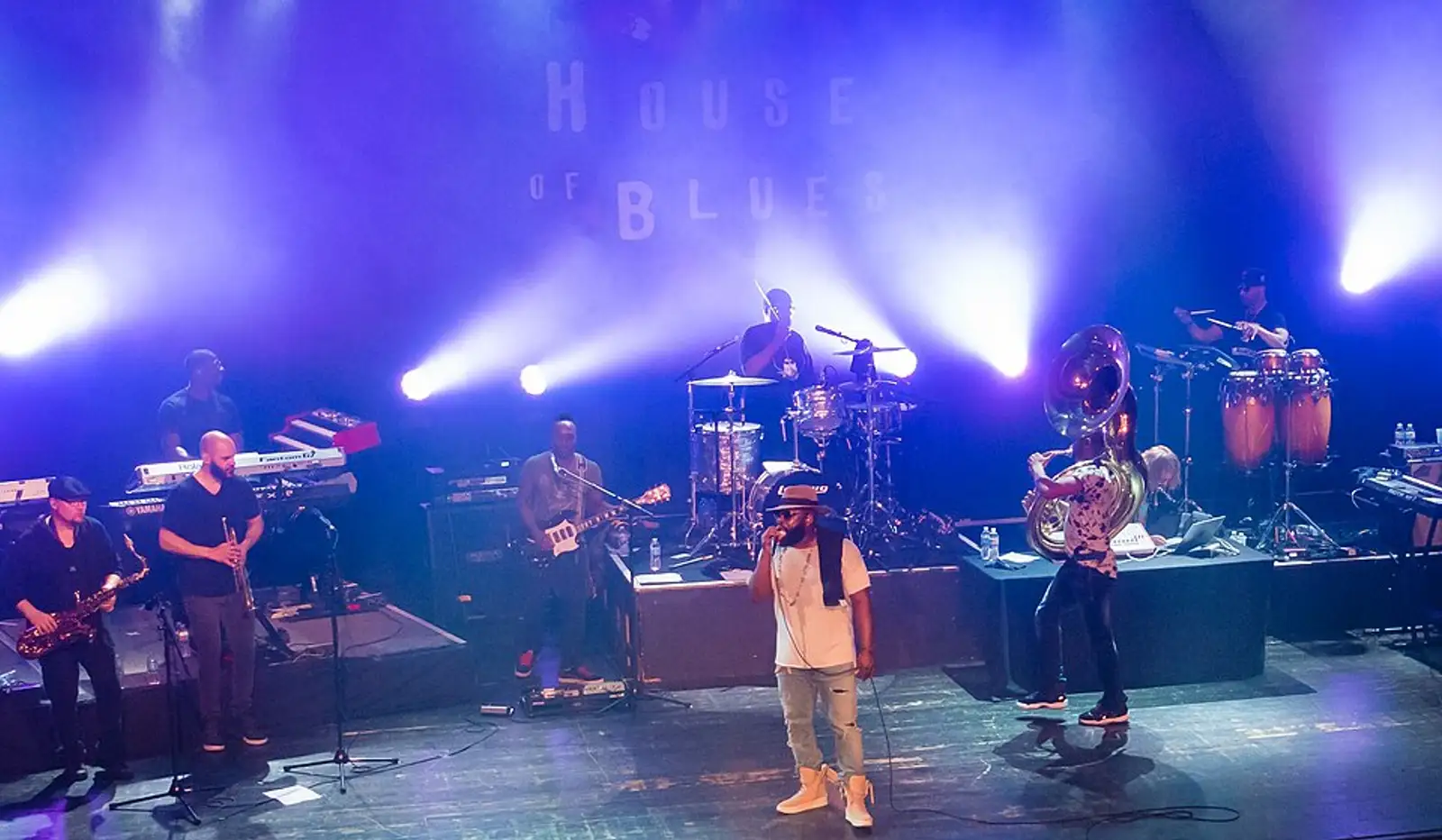
The decision to perform hip-hop with live instruments was not, in the early 1990s, obviously a good one. Hip-hop had developed a sophisticated relationship with recorded sound—sampling was not a limitation but an aesthetic, a way of building new meaning from existing cultural material. To replace that with live performance risked seeming regressive, like a band insisting on playing jazz at a time when everyone had agreed that electronics were more interesting.
The Roots made it work by understanding that the point was not authenticity in any simple sense. Questlove's drumming was not trying to replicate a drum machine; it was doing something drums can do that machines cannot, which is breathe, hesitate, and push. The live band created a rhythmic conversation rather than a rhythmic grid, and that conversation gave Black Thought's verses a different kind of room to move. The words were not sitting on top of a beat. They were inside a texture.
This matters because it changed what the lyrics could do. Black Thought's lyricism has always operated through density and compression—meaning packed tightly, references layered, contradictions held rather than resolved. As one critic noted: "Black Thought's lyricism is defined by density and compression—meaning packed tightly, references layered, contradictions held rather than resolved. The commercialization of hip-hop rewarded accessibility, and Black Thought never fully capitulated to that pressure, which is part of why his reputation among serious listeners outpaces his mainstream profile but also why he retains the respect of the most demanding listeners."
That reputation was built over time, through consistent work that did not always receive commensurate attention. "Their ability to arrange complex ideas across long-form albums without losing momentum is not a party trick." It is the result of deliberate craft, practiced across decades.
Questlove as Architect
Ahmir Thompson's role in The Roots is not reducible to drumming, though the drumming alone would be enough to secure a significant reputation. He functions as the band's primary aesthetic architect—the person who holds in his head the full range of what the group is capable of and decides, album by album, which part of that range to explore.
His curatorial instinct is evident in the records. *Things Fall Apart* arrived in 1999 as a kind of deliberate intervention, a hip-hop album made at the peak of the shiny suit era that was explicitly elegiac—mourning something about the culture even as it participated in it. *Phrenology* in 2002 went further, incorporating rock textures, jazz improvisation, and spoken word in ways that should have felt incoherent but instead felt like an argument. The argument was that genre boundaries were administrative fictions, and The Roots were not going to observe them.
Questlove's outside projects reinforced this sense of someone perpetually in motion. His work as a producer for other artists, his collaborations across genre lines, his role as musical director for *The Tonight Show Starring Jimmy Fallon*—all of these extended the reach of his aesthetic without diluting it. He is one of the few figures in contemporary music who can move between critical credibility and mainstream visibility without appearing to compromise either.
Black Thought in Full
Tariq Trotter's standing as a lyricist has always been somewhat puzzling to examine from the outside. "Tariq Trotter's standing as a lyricist has always been somewhat curious to those examining it from the outside." He is regarded by other MCs and by serious hip-hop critics as one of the finest rappers alive, and has been for twenty years. Yet he has never had a mainstream solo hit, never been at the center of a cultural moment in the way that MCs with a fraction of his technical ability have been.
The 2017 Flex freestyle changed something in public perception, if not in the estimation of those already paying attention. "His 2017 freestyle for Funk Flex—reportedly done in one take—circulated widely enough to reach listeners who had somehow missed thirty years of consistent excellence, confirming what his admirers had argued for decades: that his command of extended improvised forms is without peer in the genre, or close to it, among practitioners of extended improvised forms."
His solo work has been similarly underappreciated: "His solo work, including *Streams of Thought Vol. 1–3*, represents some of the most demanding hip-hop made in the last decade—music that expects the listener to meet it halfway and rewards those who do with something that feels genuinely commensurate with the attention it deserves."
*Tonight Show* Years and the Long Residency
The decision to become the house band for *The Tonight Show* in 2014 was received with some skepticism in certain quarters. Late-night television is not where serious artists go; it is where careers go to become comfortable and slightly irrelevant.
What actually happened was different. "The pattern of an artist accepting mainstream visibility only to use it as a platform for genuine artistic risk is rare enough to warrant attention—and The Roots executed it with a consistency that required real precision." The *Tonight Show* gig gave the band a platform, a budget, and a national audience that their album sales had never quite delivered. They used it with some intelligence: the musical segments became known for genuine craft, and the band's visible enjoyment of the work communicated something about their relationship to performance.
This is not to say the move was without cost. There is a version of The Roots that, had they not taken the residency, might have made several more albums of the *Rising Down* variety—politically urgent, sonically uncompromising work that challenges its audience. That version of the band exists only in hypothetical. The actual band made a different choice and has lived with it productively.
The Album as Argument
The Roots' best records function as arguments. "The arc of a Roots album is not decorative—it is argumentative, building a case across fifty minutes for a particular way of understanding the world that produced it." *Things Fall Apart* argues that hip-hop's commercial turn is a betrayal of something essential. *Phrenology* argues that genre is a cage. *Game Theory* argues that the post-9/11 American moment requires a specific kind of clear-eyed despair. *How I Got Over* argues that despair is not the last word.
This argumentative quality distinguishes The Roots from most of their contemporaries. Hip-hop albums are often collections of tracks, sequenced more or less carefully but not structured to make a point. The Roots albums feel written in a different sense: they have theses, they develop, they conclude.
What Remains
Three decades in, The Roots occupy a position in American music that is genuinely unusual. "Their longevity is not merely a function of talent—it reflects a set of commitments to craft, to collaboration, and to the idea that hip-hop is capacious enough to contain everything they want to put into it, commitments that require constant renewal."
The commitments have held. The band that Questlove and Black Thought formed at CAPA is recognizably continuous with the band that appears on *The Tonight Show* four nights a week and releases records that critics treat with serious attention. The through-line is not nostalgia for an earlier version of themselves; it is fidelity to a set of artistic values that they identified early and have not abandoned.
"Philadelphia, the genre, and the peculiar institution of late-night television all leave their marks on what The Roots make—a body of work more various and more demanding than the band's public profile suggests, and more fully achieved than most of their contemporaries will produce in the time they have left, whatever the genre contained."
That is an unusual thing to be able to say about any artist thirty years in. The Roots have earned it.
Share this Article
Subscribe to our Newsletter
Stay connected with the latest in music, culture, and exclusive content
By subscribing, you agree to our Privacy Policy and Terms of Use