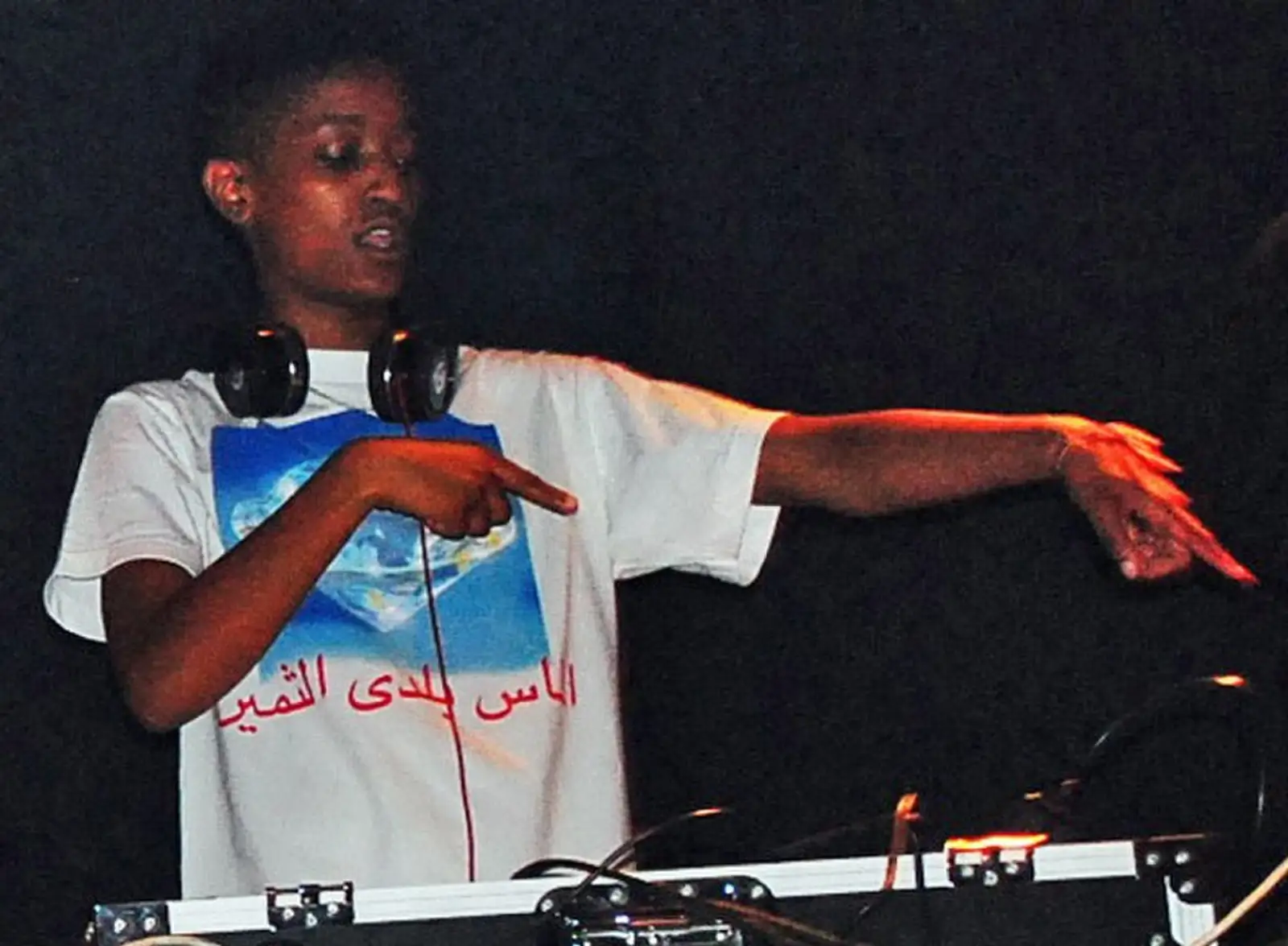
Picture a teenager behind the board. Not in the frame, not on the mic, but adjusting levels, shaping sound, learning the internal logic of music from the inside out. This is where Syd's story begins: not as a solo artist delivered to the world, but as the technical and sonic infrastructure of one of the most discussed collectives in American music, present at the foundation of something large while the cameras pointed elsewhere. That origin is not incidental to what she became. It is the blueprint.
The Room Where It Started: Odd Future and the Engineer at the Board
Syd joined Odd Future as a teenager, working as sound engineer and DJ at a time when the collective was defined publicly by the personas of Tyler, the Creator and Earl Sweatshirt. The labor was central; the recognition was peripheral. Her work shaped the sonic texture of a collective that would go on to define a particular strand of early-2010s American youth culture, yet the dominant narrative of Odd Future was built around faces and voices that were not hers.
The collective's early years were defined by provocation, a deliberate and often exhausting performance of transgression that generated enormous attention and equally enormous debate. Syd's queerness existed inside that space in an unusually unresolved tension: present but rarely centered, visible but not performed for the audience consuming the content. She was neither hidden nor celebrated. She simply was, which in that context amounted to a quiet form of resistance.
Her technical role gave her something more durable than attention: it gave her fluency. The warmth in her productions, the low-end intimacy, the sense that her records are built from the inside out rather than produced for external effect — these are not superficial stylistic choices. They are the signatures of someone who learned music by understanding how it is constructed at the molecular level, long before she learned how to present herself as its face.
To understand Odd Future properly is to resist treating it as a viral moment and instead examine it as a Los Angeles-rooted scene with real geography, real community infrastructure, and real DIY practice underpinning the chaos. That grounding — suburban, Black, deeply online but also tethered to physical space and local networks — shaped every artist who came out of it. Syd included, and perhaps Syd most of all, because she internalized the architecture rather than performing the spectacle.
The Internet and the Construction of a New R&B Interiority
The Internet, the band Syd co-founded with producer Matt Martians, arrived as part of a wave of artists renegotiating what R&B could feel like: slower, more ambiguous, less concerned with radio formatting. But where many peers were engaged in a kind of genre renovation, The Internet felt like something more committed: a sustained argument, across multiple albums, that Black music could hold softness, ambivalence, and queerness without explaining itself to anyone.
Ego Death, released in 2015, and Hive Mind, which followed in 2018, established the band as a project interested in texture and mood over hook mechanics. These are records that reward prolonged listening the way soul and jazz records from earlier decades do — albums where emotional payload accumulates across repeated plays rather than arriving upfront, engineered for immediate consumption. The patience they require is itself part of the aesthetic argument.
The band's collaborative structure served Syd in a way that a premature solo launch would not have. It gave her space to develop as a vocalist and frontperson gradually, in a context where the creative weight was shared, where she could find her voice without the distorting pressure of being solely responsible for a record's commercial fate. That developmental patience is rare in an industry that prefers to ignite and consume.
Hive Mind marked a particular deepening: a shift toward a more consciously Black and Southern California-rooted sonic palette, drawing on funk, jazz, and gospel in ways that expanded the band's lineage claims beyond their immediate peer set. The record situated The Internet inside a much longer tradition of Black West Coast music, making audible a cultural inheritance the band had always carried but had not yet made so explicit. The audience that found them through this work — loyal, cross-genre, deeply invested — was built through consistency and artistic integrity rather than marketing cycles, which helps explain why the catalog has grown in stature rather than fading with hype.
Sinning and Telling: Syd's Solo Work as Confessional Architecture
Syd's debut solo album Fin, released in 2017, presented listeners with an intimate cartography of Black queer desire. The record functioned less like a conventional R&B release and more like an interior space — a room designed for a listener who had rarely been directly addressed by the genre. Where The Internet's work carried the warmth of collaboration, Fin insisted on something more exposed: a first-person vulnerability with nowhere to hide behind a band's collective identity.
The directness of Fin's perspective — a Black queer woman narrating romantic and sexual experience on her own terms, without apology or qualification — was unusual in mainstream R&B, which has historically either ignored queer desire or coded it into deliberate ambiguity designed to preserve deniability. Syd offered no such deniability. The specificity of her gaze was the point.
The production choices across her solo material — muted tones, deliberate pacing, an almost architectural use of space and silence — function as formal arguments. The music refuses urgency, refuses performed accessibility, refuses the seduction narrative as it has traditionally been gendered in R&B. These are not passive aesthetic choices. They are positions, taken seriously and held consistently, about what intimacy sounds like when it is not being staged for someone else's consumption.
The gap between solo albums would be a mistake to read through the lens of industry momentum — as absence, stall, or faltering. An artistic practice built around integrity of expression rather than market pressure operates on a different clock entirely. For a Black woman in a genre that typically demands constant output, releasing only when the work is genuinely ready is itself a statement about what the work is for.
Her lyrical perspective consistently centers the emotional labor of desire — the uncertainty, the longing, the complicated aftermath of intimacy — rather than the performance of desirability. This marks a meaningful departure from how Black women's sexuality has been framed in the commercial mainstream of the genre, where desirability is often the primary currency and interiority is secondary to spectacle. Syd inverts this completely.
Black Femininity and the Genre's Unspoken Contract
R&B has a complex and often exploitative relationship with Black women's bodies, voices, and desires. The genre's commercial conventions have historically required Black women performers to embody desire for an implied male audience — to be available, legible, and emotionally spectacular in ways that serve an external gaze. This framework does not accommodate a queer woman narrating her own longing on her own terms. It was not built for her. Syd builds in the space it refused to construct.
Understanding her work requires reaching back through a lineage of Black queer musicians who worked in soul and R&B long before mainstream visibility became possible — Meshell Ndegeocello most prominently, but also a broader tradition of artists who navigated these negotiations across decades, finding ways to make honest work inside and around a genre that was not designed to receive them honestly. Syd is not an outlier; she is the most recent iteration of a much longer story.
The critical language deployed around Black women in R&B tends to default to resilience narratives or empowerment framings — both inadequate containers for what Syd actually does. Her work is not interested in legibility as strength. It is interested in ambiguity, softness, and emotional complexity that resists the inspirational resolution those frameworks demand. Applying them to her work is a category error that flattens what makes it significant.
Syd's refusal to perform her identity for external consumption — in interviews, in lyrics, in visual presentation — is itself a political stance inside an industry that has historically profited from the spectacularization of Black queer identity while marginalizing the people who hold it. The refusal to be a spectacle, for an artist in her position, is an act of sustained intention. It requires constant recommitment in an environment designed to extract performance.
Los Angeles as Sonic and Cultural Ground
Syd's work is rooted in a specific Los Angeles that rarely appears in the city's own mythology — not the Hollywood industry city, not the Sunset Strip, not the version sold back to itself through entertainment. Her Los Angeles is the Black and brown communities of the San Fernando Valley and South LA: the DIY studio culture, the low-rider inheritance, the neo-soul continuum running through the city's musical DNA like an underground river.
Odd Future emerged from a geography rarely centered in accounts of Los Angeles music history — suburban, Black, deeply online but also rooted in physical community and local scene infrastructure. This is the same city that produced Central Avenue jazz culture, the golden era of West Coast hip-hop, and the neo-soul generation associated with artists like Raphael Saadiq and Thundercat. Syd's work consciously and unconsciously inherits all of it, drawing on a lineage that is long and specific and too often overlooked in favor of more spectacular versions of the city's musical self-image.
Los Angeles has a particular relationship to car culture, private space, and the long drive that shapes a certain kind of music — music that moves slowly, fills interior space rather than commanding a room, designed for the contemplative rather than the communal. Syd's catalog is among the clearest contemporary expressions of this sonic tradition. Her records make the most sense when you are moving through space alone, which is perhaps the most distinctly Los Angeles context there is.
Understanding Los Angeles as a global city — with deep connections to Black diasporic culture, West African and Caribbean communities, and transnational creative networks — also clarifies why Syd's music has found audiences far beyond the United States. In communities across the world where Black queer identity intersects with similar cultural negotiations, her work arrives not as an exotic American export but as something that speaks to experiences the listener already knows. Place, paradoxically, becomes the thing that makes the work universal.
Quiet Significance: What Syd's Trajectory Tells Us About Artistic Longevity
The broader argument of Syd's career is one about durability — about what it means to build something that lasts rather than something that merely performs the appearance of lasting. Artists who work at the pace of their own creative necessity rather than market demand often become more significant over time, not less. Each release in her catalog deepens the coherence of a sustained artistic vision rather than pivoting toward whatever the industry has identified as the next viable sound. That accumulation is its own form of authority.
Her influence on a younger generation of Black queer artists working in R&B and adjacent spaces is real and traceable, even where it goes uncredited. This is foundational influence that operates through permission and possibility rather than direct stylistic imitation — the influence of demonstrating that a particular kind of work can exist, that an audience for it can be built, that the genre can hold what it was told it could not hold. That permission, once granted, cannot be revoked.
The story of Syd resists the conventional music industry narrative of ascent, peak, and decline — the arc the industry imposes on artists to organize its own attention cycles. What she offers instead is a model of artistic integrity that may be more useful and more honest about how culture actually accumulates meaning: not in peaks but in depth, not in moments but in the slow, patient construction of a body of work that continues to mean something long after the original context has shifted.
In a global context where Black queer artists across multiple continents are navigating similar negotiations between identity, genre, and community — finding ways to make honest work inside structures not designed to receive it — Syd's catalog offers a reference point that transcends its American origins. The teenager behind the board at an Odd Future session, learning how music is built before learning how to perform it, was already constructing something. What she built, it turns out, was a room where a great many people could finally hear themselves.
Share this Article
Subscribe to our Newsletter
Stay connected with the latest in music, culture, and exclusive content
By subscribing, you agree to our Privacy Policy and Terms of Use